News & Insights
Eric H. Chudler Champions Curiosity and Access
Recipient of the 2026 Dana Foundation Neuroscience & Society Champion Award
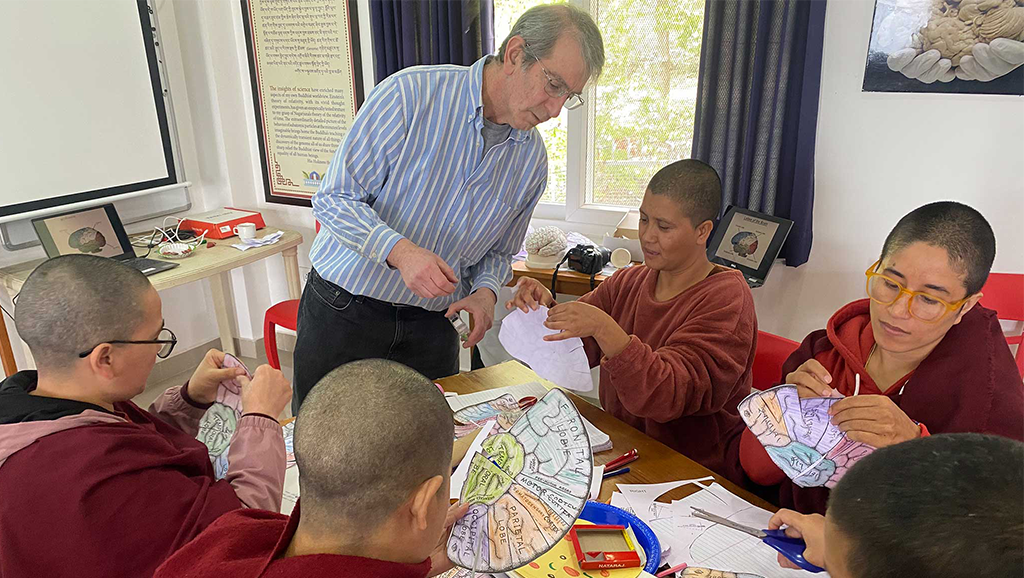
During a Science for Monks and Nuns workshop in Dharamsala, India, Eric Chudler works with Tibetan Buddhist nuns on an activity to better understand brain anatomy. Photo courtesy of Eric Chudler.
A Tibetan Buddhist monk once told Eric H. Chudler, Ph.D., that he was very disappointed in him. Chudler had come thousands of miles to teach neuroscience, the monk said, and whenever the class asked a difficult question, like “where in the brain is consciousness,” he answered, “I don’t know.”
For Chudler, that answer is the point. For three decades, he has started by listening: asking learners what they want to know, and being honest about what science can’t yet say. That habit shaped Neuroscience for Kids, which he built in the Internet’s early days, and his classes for neurodiverse teens, older adults, and monastic scholars in India. It also shaped his work at the University of Washington’s Center for Neurotechnology, where he helped build neuroethics into training for students and teachers from the start, when few engineering centers did.
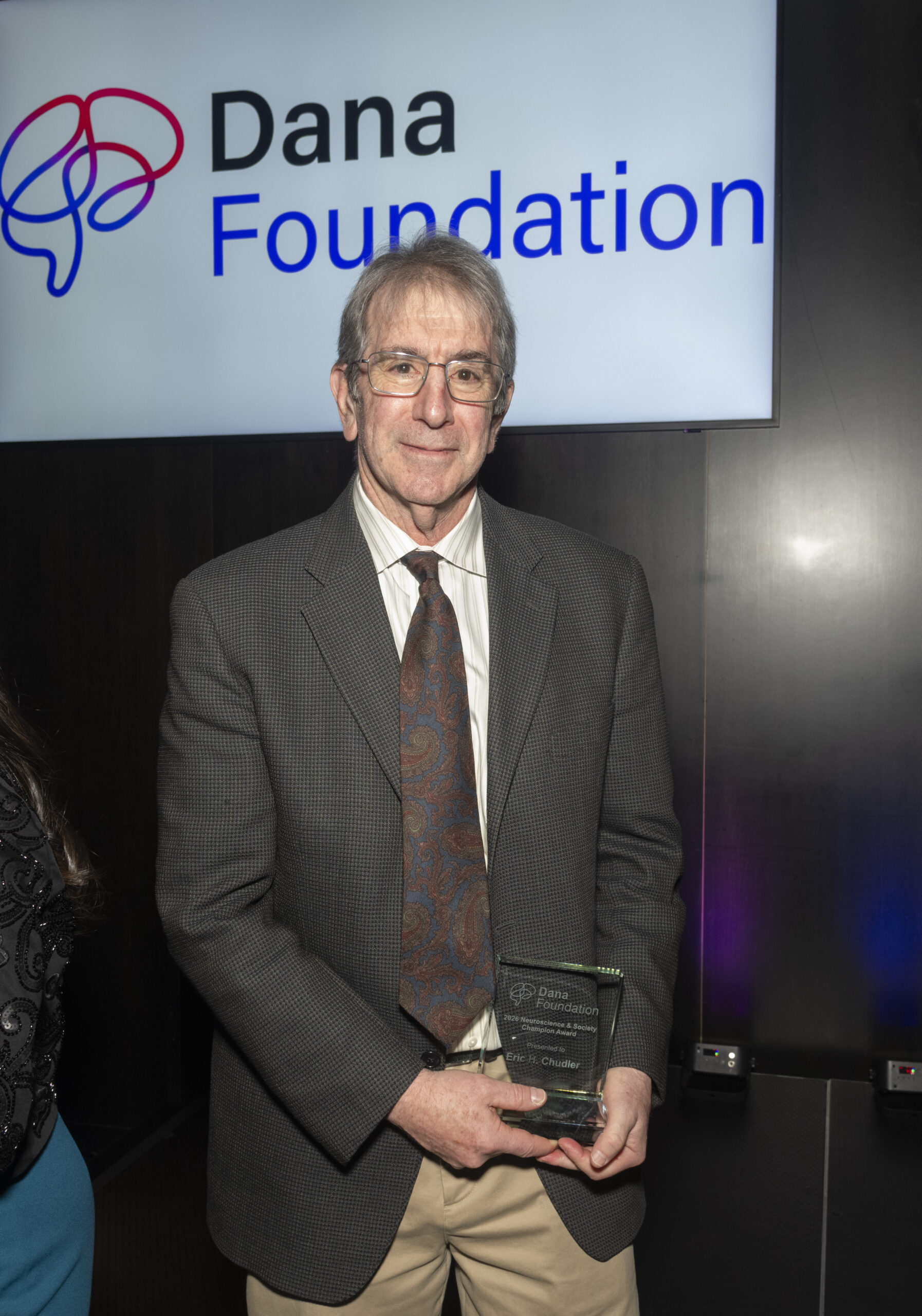
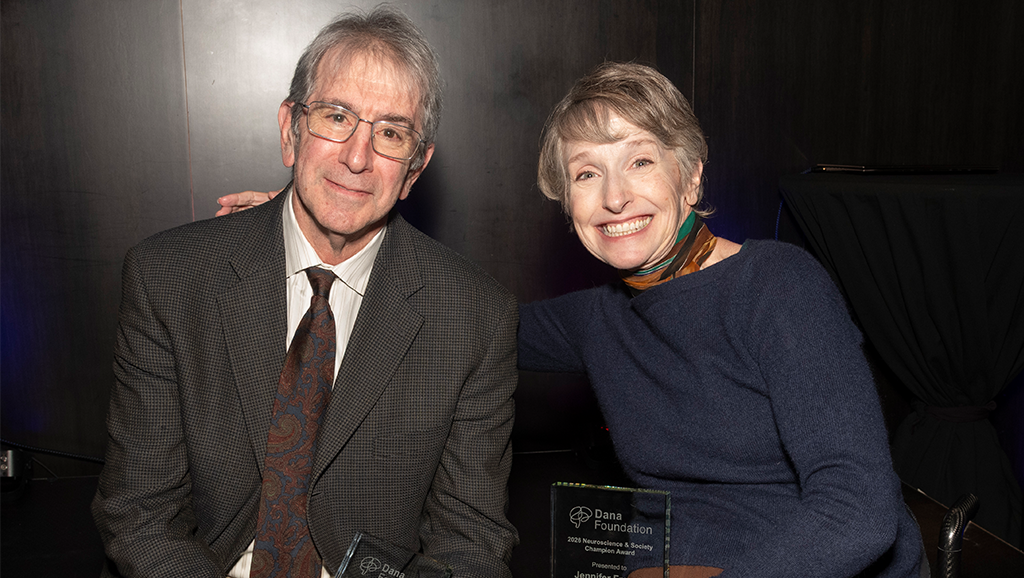
Eric Chudler with his award at a Dana Foundation reception held during the 2026 Society for Neuroscience meeting in DC.
Chudler, a research associate professor emeritus at the University of Washington and executive director of its Center for Neurotechnology, was recently honored by the Dana Foundation as one of two 2026 recipients of its Neuroscience & Society Champion Awards. Here, he talks about where his outreach began, what the monks taught him, how ethics became part of the center, and why he keeps showing up in person.
Neuroscience for Kids launched about 30 years ago, before most scientists had websites. Where did it begin?
In my daughter’s preschool. The school had a day when parents came in to tell the kids what they did, so I talked about being a scientist. The teachers kept asking me back, year after year. Then they told other teachers, and I couldn’t do it all.
The Internet was just starting to take off, and I thought, wait a second, this Internet thing might be useful for education. So I taught myself HTML. Neuroscience for Kids was about making the material available to teachers who didn’t have access to me.
I’ve been on the research track my entire career, so teaching has never been part of my official responsibilities. But both of my parents were schoolteachers, and they instilled in me the importance of education and of giving back to the community. Maybe education is in my blood. And, of course, I’ve had teachers myself. I’ve always tried to bring into my own teaching what the good ones did well, like their manner of speaking, their gestures, and eye contact.
What have you found makes the workings of the brain “click” for people?
Make it relevant. Don’t just throw facts and figures at people. If people don’t know why something is important for themselves, why should they care? And that means asking them what they want to learn.
I had my own ideas about what others want to learn, but the answers often surprised me. In Neuroscience for Neurodiverse Learners, many of the students are musicians, and they wanted to know how the brain is involved with music, so I made a lecture about music. They were also interested in meditation. I’m not an expert meditator, but I created a lecture on how meditation changes the brain.
For the Dana-funded Brain Health Learning Network, we held focus groups with older adults, a group I’m part of now. I expected they’d want to know about memory loss, Alzheimer’s, and stroke, and they did. But they also wanted to know how to evaluate what they hear, see, and read, and how to identify scientific misinformation. That’s not my expertise, so I brought in a University of Washington colleague who is an expert.
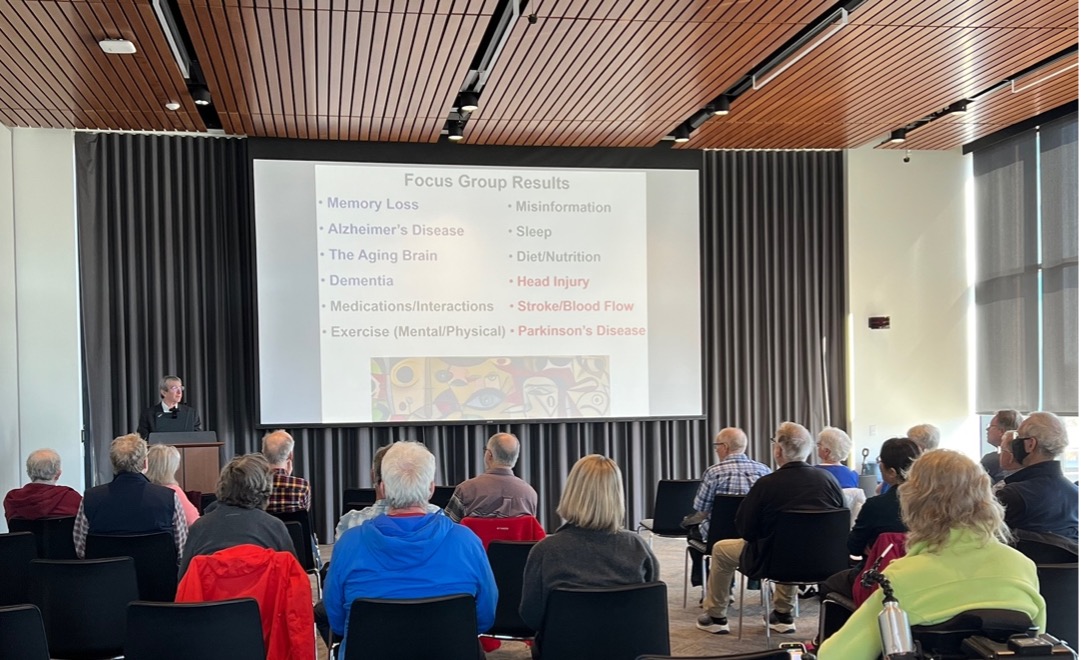
Chudler speaks with a group of older adults during a program for the Brain Health Learning Network. Photo courtesy of Eric Chudler.
You’ve taught Tibetan Buddhist monks and nuns in India about ten times since 2011. What have they taught you?
Every time I go, and they’re all different groups, they ask me the same question. By the fourth or fifth trip, I headed it off when I introduced myself. I’d say: I know what you’re going to ask me. Your first question is, where in the brain is consciousness? My answer is, I don’t know. Your second question is, after you die, where does consciousness go? My answer is, I don’t know.
One time, during the tea break between lectures, a monk came up to me and said, through a translator, “I’m very disappointed in you.” I asked if I’d broken some taboo. He said, “Every time we ask you a difficult question, you answer, ‘I don’t know.’ You’ve come thousands of miles to teach us, and you keep saying you don’t know.”
I said, I’m being honest with you. In science, it’s okay to say you don’t know.
Debate is very important for Tibetan Buddhist monastics, and other monks overheard. One came to my defense. If he tells you something and you later find out it isn’t true, he said, you won’t believe anything he says. Saying “I don’t know” leads to more questions, and that’s how science progresses.
The monks and nuns remind me how much more there is to learn. Compassion is a central tenet of Tibetan Buddhism, and they taught me to listen better. When people in our Brain Health Learning Network focus groups, some in their 80s and 90s, talked about forgetting things, or about spouses with memory loss or depression, I tried to put myself in their shoes and really listen.
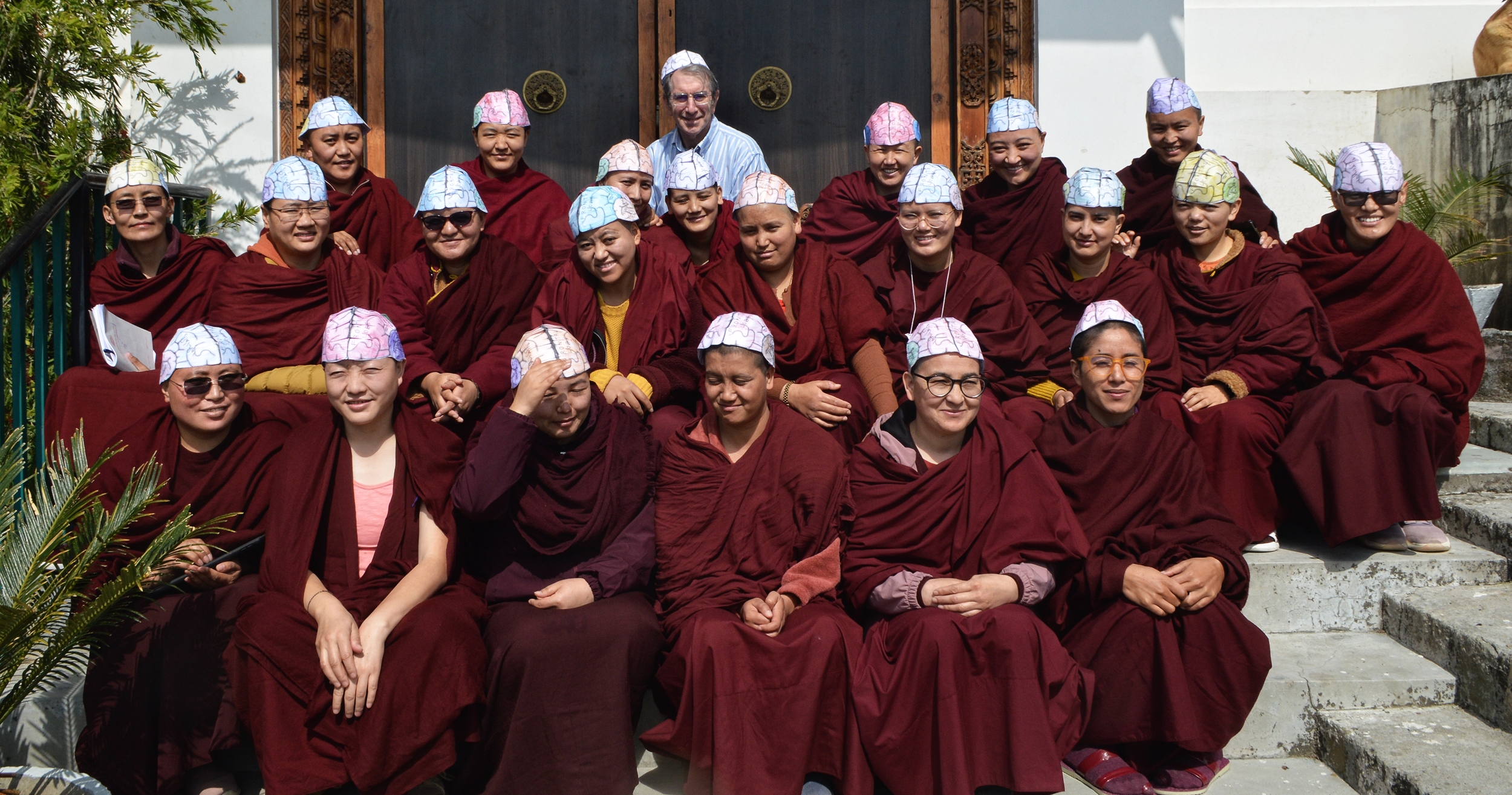
Chudler and Tibetan Buddhist nuns posing with their brain anatomy hats after completing the lesson. Photo courtesy of Eric Chudler.
Neuroethics became part of the Center for Neurotechnology from the start. What was your role?
When the Center was established in 2011 as a National Science Foundation (NSF) Engineering Research Center, the original director, Yoky Matsuoka, and the other leaders decided that neuroethics should be front and center, on par with the engineering and science. Every director since, including Tom Daniel and current directors Chet Moritz and Rajesh Rao, has kept it that way.
As executive director and education director, my job was to make sure that commitment came through, especially in our education programs. In our Research Experience for Undergraduates program, we always embedded a student in the neuroethics labs of Sara Goering and Eran Klein, just as engineering or physiology labs got students. In our Research Experience for Teachers program, high school teachers were trained in neuroethics. They worked through case studies, like a patient who feels he’s lost part of himself after deep brain stimulation, or a student who borrows a brain-stimulation headset to study longer. Then they wrote lessons for their own classrooms on privacy, identity, and enhancement.
Rather than give a big chunk of money to one lab, the center has funded students in many labs, and that seed funding helped labs win new NIH and NSF grants. In my opinion, that’s the legacy of the Center, along with the students who were trained. For example, Tim Brown was a philosophy graduate student working with Sara, funded by the center, and now he’s a professor in bioethics and humanities at the University of Washington School of Medicine.
How has working with different learners changed the way you design programs?
We’ve run Neuroscience for Neurodiverse Learners for about seven years with DO-IT (Disabilities, Opportunities, Internetworking, and Technology). Early on, the DO-IT staff reminded me that I sometimes talk fast, so I slowed down. I also started stopping halfway through. An hour and a half is too long for a lecture, so: here’s a five-minute break, get up, stretch, have something to drink. Now I do that with other groups too.
I always use demonstrations, hands-on activities, art, something other than just talking. And I leave time for questions. In India, I’m usually there about two weeks, giving two lectures a day, and I can’t get to every question, so we have a question box. Students write their questions, often in Tibetan, and the translators have them in English for me the next day.
That gives participants ownership. They choose what they learn, and they can guide the discussion. That makes it more meaningful.
What can in-person, community-based learning do that a website or a video lecture can’t?
Build trust. Zoom has given us a tremendous technology, but it has also created an impersonal space, and something is lost. Seeing someone face to face, rather than a head bobbing on a screen, shows that scientists are people too.
As a presenter, I can look people in the eye and see when I’m losing them, and then take my break or change what I’m doing. I use the seven-second rule: ask a question, look around, let them squirm a little, and someone usually speaks up. Seven seconds is a long time. The monks and nuns are usually quiet at the start, but by the end of two weeks, they’re noisy, very interactive and full of questions.
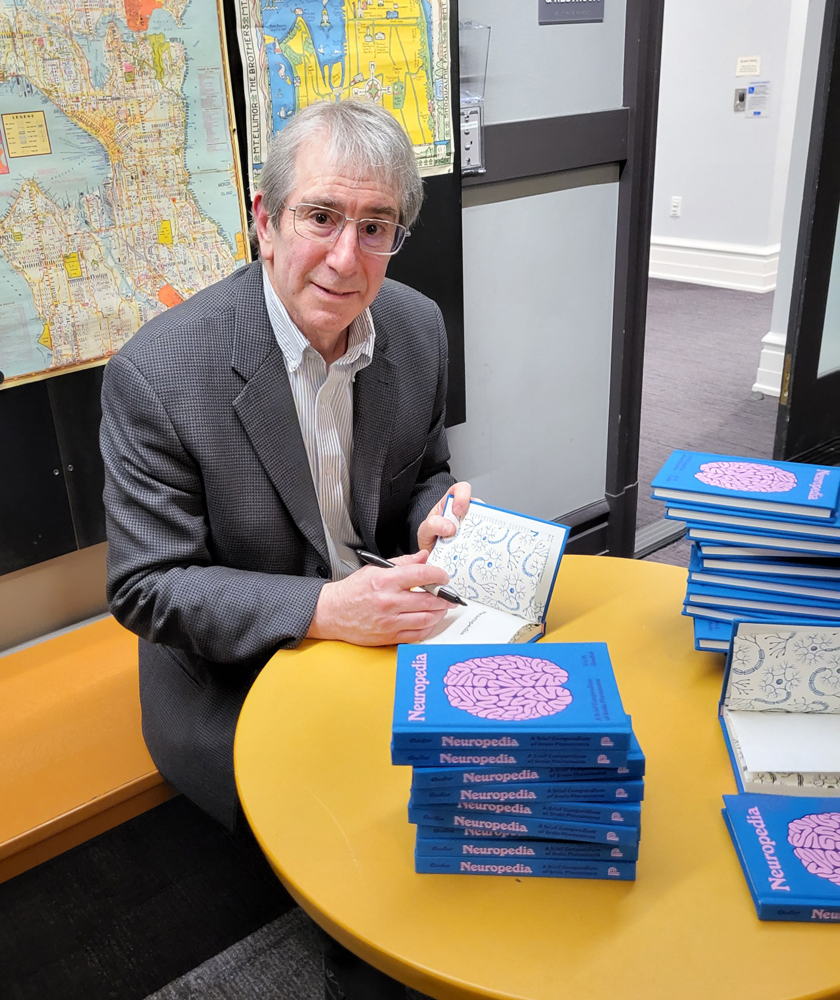
Chudler signing copies of Neuropedia: A Brief Compendium of Brain Phenomena, one of several books he’s authored about the brain. Photo courtesy of Eric Chudler.
What’s next for you?
I’ve reduced my time at the University of Washington, but I’m still busy. This summer, Horacio de la Iglesia and I ran our NIH-funded UW ENDURE program, which placed 10 undergraduates in neuroscience labs. I taught them scientific communication, and in November they’ll present their research at the Society for Neuroscience meeting. Most have never been, and it can be overwhelming, so I wrote them an eight-page guide, “Surviving the SfN Meeting.”
I have a neuroscience book for the public coming out in 2027, illustrated by my wife. I’d like to give Neuroscience for Kids a modern overhaul; the core material is still good, but the interface is old school. School groups still visit me nearly every month, and in March I’m going back to India to teach a new group of nuns.
For anyone who wants to champion neuroscience and society, it comes back to the beginning: make it relevant, make it meaningful, and give people ownership of their own learning. That goes a long way.