President's Perspective
How Well Do We Live Our Values?

Values matter most when they are tested—not when they are written down, but when they are practiced, examined, and experienced by those we work alongside. For organizations that fund science, this is especially true today, at a moment when public trust in science and scientific institutions is increasingly fragile. How we lead, how we partner, and how we exercise responsibility and power shape not only the work we support, but also the confidence others place in the scientific enterprise itself.
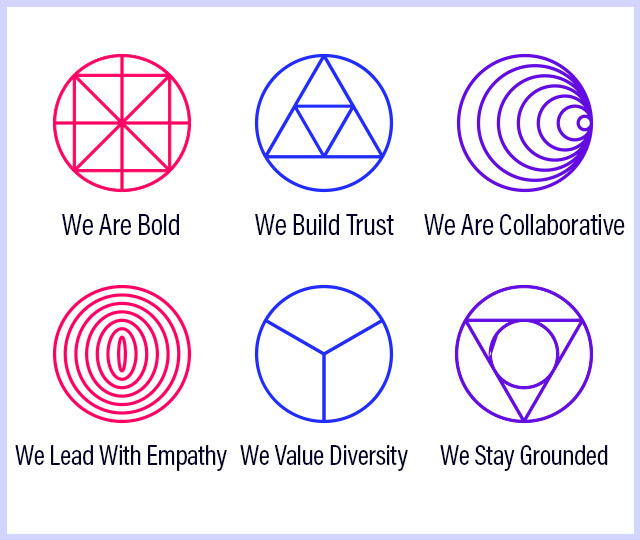
When I began envisioning the Dana Foundation’s neuroscience and society mission five years ago, I believed it was essential to articulate a clear set of organizational values. Drawing on Dana’s history, conversations with staff and board members, insights from partners, and my own leadership experience, we worked collaboratively to define not only what we aim to achieve, but how we commit to working together to get there.
For us, living our values means allowing them to shape everyday decisions: how we design programs, how we partner with grantees, how we structure internal processes, and how we decide what and how to fund. This article shares our experience applying a values-based framework in practice, with the goal of helping other foundation leaders build greater trust, accountability, and impact in their work.
From Articulation to Accountability
Organizational values are most powerful when they are experienced as real by those we engage with. That conviction led us, last year, to take an important next step: asking our grantees whether we were living up to the values we had defined.
This effort marked the first phase of a multi-stage learning and evaluation approach, led by our vice president, Khara Ramos, in close collaboration with the Neuroscience & Society programs team and leadership across the Dana Center Initiative. This work was not requested by our board or required by any external stakeholder—it was a choice rooted in our values themselves.
If we ask others to operate with integrity, humility, and courage, we must be willing to hold ourselves to the same standard.
A Values-Based Evaluation Framework
Working with Catalyst Consulting as an independent evaluator, we used mixed social-science methods, including surveys, interviews, and facilitated discussions—to explore three core questions that may be relevant to any foundation committed to trust-based practice:
- How are our values experienced in day-to-day relationships with grantees?
- To what extent do we lead through inclusive practice?
- To what extent are we perceived as trustworthy partners?
We invited principal investigators from grants awarded between 2022 and 2025, including those who participated in a pilot grant but did not go on to receive follow-on funding. The goal was not affirmation, but learning.
The results were both encouraging and instructive, and they reinforced our belief that values themselves can be a meaningful focus of evaluation.
What We Learned
Exemplifying our values
Grantees provided feedback across four dimensions: authenticity, stakeholder visibility (transparency and clarity), trust in integrity, and trust in benevolence. Ratings were consistently high, with trust in integrity and authenticity rated strongest overall. These findings affirmed that values can serve as a foundation for open, credible relationships, while also highlighting where continued attention is needed.
Leading through inclusive practice
Every grantee shared at least one example of feeling included, through being invited into conversations, feeling heard, experiencing responsiveness, or developing genuine relationships. When asked how inclusion could be strengthened, many pointed to a desire for greater connection and community among grantees. This insight is already shaping how we think about convening and network-building moving forward.
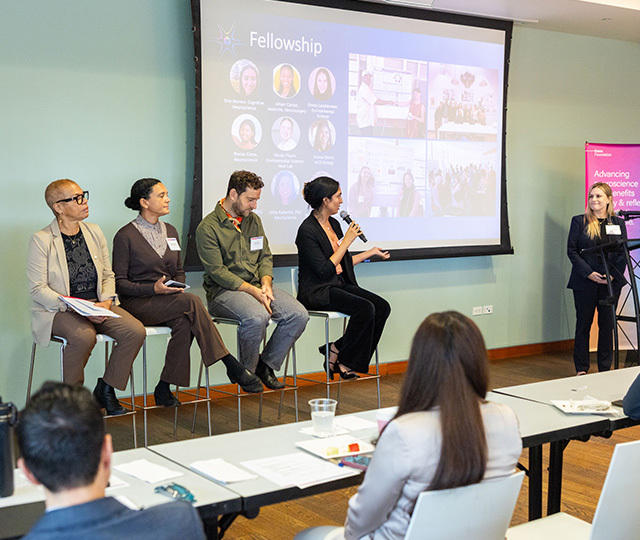
Dana staff and grantees convening at the Dana Center Initiative meeting in Santa Monica, 2025.
Trustworthiness in practice
Grantees described strong relational trust with the Dana staff members they worked with most closely. All shared examples of benevolence, with staff going above and beyond, listening deeply, or remaining open to new perspectives. Ninety-five percent cited integrity, including follow-through on commitments and clear motivation to support the work. Most also described benefiting from staff competence, expertise, or lived experience.
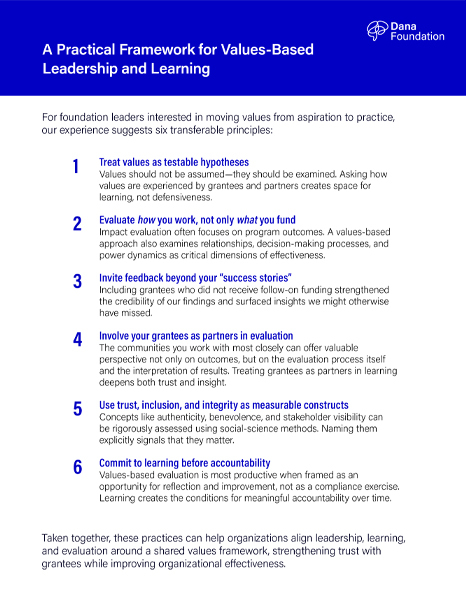
A Practical Framework for Values-Based Leadership and Learning
Living the Commitment
Living our values—like doing good science—is an ongoing process of assessment and refinement. It requires the courage to surface what is difficult, the discipline to listen carefully, and the humility to adjust course when needed. Most of all, it calls for a mindset of continuous learning and accountability.
As we move into 2026, we are entering a new phase of learning and evaluation focused on the outcomes and impact of our grantees’ work. What we learn will inform program decisions and ways of operating into 2027 and beyond.
When values are lived, tested, and refined in partnership with others, they become more than principles. They become a source of trust, learning, and shared progress. We share this approach as a case study of a practical, values-based framework for other foundation leaders seeking to strengthen trust, accountability, and impact in their own work.