President's Perspective
Strengthening Trainee Skills Through Brain Awareness Week


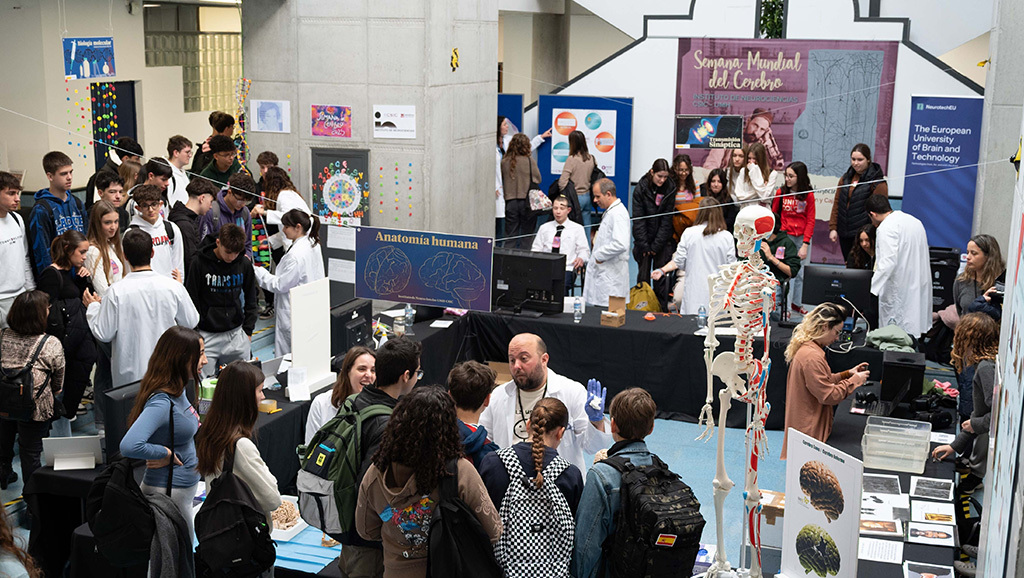
For more than three decades, Brain Awareness Week has brought together scientists, educators, students, and community members to share in learning about—and celebrating—the wonders of the brain. Launched by the Dana Foundation in 1996 as a US-based initiative, it has grown into a global campaign spanning 65 countries across six continents.
This annual public engagement initiative aims to foster enthusiasm for brain science, strengthen dialogue between researchers and communities, and increase understanding of brain health and neurological conditions. But its impact appears to extend even further, providing critical opportunities for networking and professional growth to trainees and early career scholars.
To better understand how effectively Brain Awareness Week advances its goals, we commissioned a survey in partnership with the Federation of European Neuroscience Societies (FENS) and the International Brain Research Organization (IBRO). The survey pool included awardees who received funding from either FENS or IBRO and grant applicants who did not successfully compete within the last five years.
The findings confirmed what many of us have observed anecdotally: Brain Awareness Week is highly effective at connecting scientists and communities. Respondents reported sustained public engagement, increased dialogue between researchers and educators, expanded outreach to underserved populations, and stronger institutional partnerships. The campaign continues to make brain science visible, accessible, and relevant in diverse contexts around the world.
The survey also unveiled an added benefit of Brain Awareness Week. Across regions and institutions, its strongest and most consistent impact was reported by science trainees and early-career researchers. Participants involved in organizing and leading Brain Awareness Week events said the experience strengthened their communication skills, expanded their professional networks, and enhanced their career development. Some described gaining confidence in engaging diverse audiences, and reported that the experience generated new research ideas or influenced the direction of their work. Nearly half indicated that involvement helped them secure research funding.
These findings suggest something important. Public education initiatives like Brain Awareness Week do more than strengthen connections between science and society. They can also function as powerful launch platforms for the next generation of scientists.
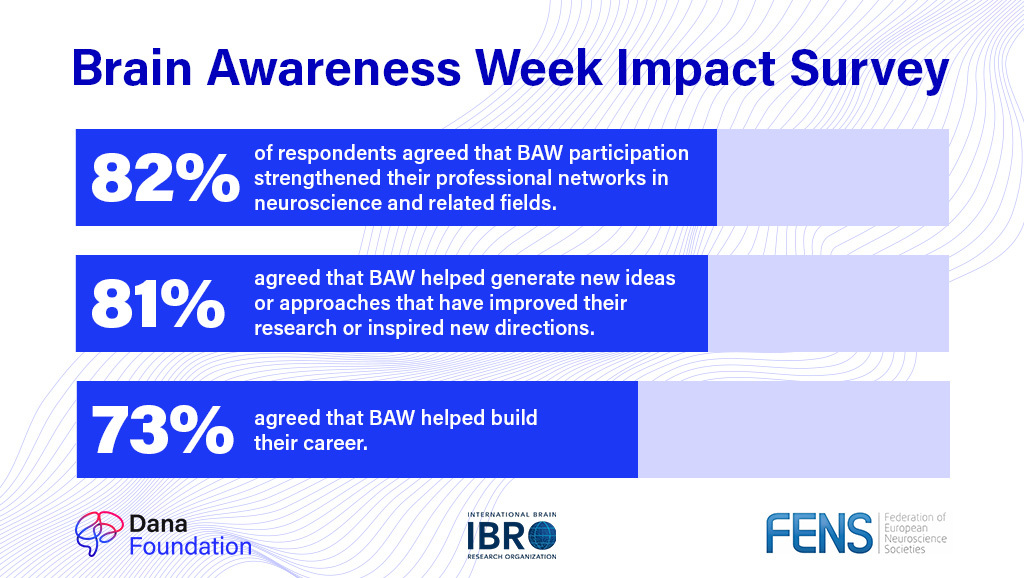
Brain Awareness Week provides structured, real-world opportunities for scientists to practice public communication, build partnerships, and translate complex ideas into accessible language. It fosters collaboration and builds relationships between researchers, schools, healthcare providers, and community organizations. It creates space for trainees to see how their work connects to the everyday lives of others. In doing so, it supports more holistic professional development. This is so important in the current landscape of rapid neuroscience advances, in which early-career scientists are increasingly expected to navigate the ethical and societal dimensions of their research as much as they are to conduct rigorous experiments. At a time when concerns about trainee retention, career sustainability, ethical implications of technology, and public trust in science are rising, multifactorial impact matters more than ever.
The global reach of Brain Awareness Week further strengthens its value as a campaign. Half of the survey respondents were based in low- or middle-income countries, and many reported having no alternative funding sources for neuroscience outreach. The association with Dana, FENS, and IBRO enhances credibility and often helps organizers secure additional institutional support. In this sense, Brain Awareness Week functions as a shared infrastructure for inclusive, globally distributed neuroscience engagement and training.
The implications are clear. Public engagement initiatives should not be viewed as peripheral to the research enterprise. They are integral to it. They build the skills, networks, and perspectives that enable scientists to thrive. They strengthen connections between institutions and communities. And they contribute to the long-term sustainability of the neuroscience workforce. When public engagement and scientific training are seen as interconnected rather than separate, the research enterprise and its impact on society grows stronger.
Brain Awareness Week has shown that engagement can be both outward-facing and inward-strengthening. The future of neuroscience depends on both. As we reflect on these findings, we also recognize that the need far exceeds current resources. Each year, more institutions and communities seek to participate than we are able to support. In partnership with FENS and IBRO, the Dana Foundation will work to broaden the base of support for Brain Awareness Week and similar initiatives. We urge science funders who invest in trainees, research productivity, and the future of the scientific workforce to view public engagement initiatives as aligned with their mission and to join us in investing in them.