President's Perspective
From Discovery to Hope: What Federal Investment in Science Makes Possible

At the recent BRAIN Initiative Conference in Maryland, I saw scientific progress measured in neural signals, sophisticated devices, and discoveries about how the brain produces memory, emotion, and behavior. Immediately following that conference, at the National Institute of Neurological Disorders and Stroke Nonprofit Forum, I encountered that progress in more human terms through research that can help someone reclaim a life disrupted by a brain condition. Together, these experiences offered a powerful reminder of what sustained federal investment in science makes possible, and why that investment matters.
My perspective is shaped by more than a decade of supporting the BRAIN Initiative as a private foundation partner, first at The Kavli Foundation and now at the Dana Foundation. During that time, I helped establish the BRAIN Initiative Alliance, facilitated the International Brain Initiative, and now serve on the NIH BRAIN Initiative Neuroethics Working Group. I have watched the Initiative grow from an ambitious vision into a research enterprise generating new tools, knowledge, and potential therapies, while cultivating a new generation of scientists.
Discoveries Lay the Foundation
What the BRAIN Initiative has made possible was clearly demonstrated in a plenary lecture by BRAIN-funded scientist Nanthia Suthana, Ph.D., who studies the neural mechanisms underlying memory and emotion. Her team records activity deep inside the human brain while people navigate virtual environments and move through the real world. This combination of intracranial recordings, wearable technologies, and naturalistic behavior gives researchers an extraordinary window into the brain as people experience everyday life.
That fundamental work is also opening possible paths to treatment. In a small, first-of-its-kind pilot study, Suthana and her colleagues identified patterns of activity in the amygdala associated with fear, anxiety, and traumatic memories in people with severe, treatment-resistant post-traumatic stress disorder. The researchers programmed implanted devices to recognize relevant neural activity and respond with targeted stimulation. After a year, the participants experienced clinically meaningful reductions in PTSD symptoms—promising early findings that now require confirmation in larger studies.
One participant was Adam Holbrook, a former U.S. Army platoon leader who served in Iraq and Afghanistan. His flashbacks had been frequent, unpredictable, and sometimes overwhelming. Following implantation of the device, they stopped. He could once again be present with his family, including during a visit to Disneyland, where he watched the fireworks without being pulled back into memories of combat.
Science Powers the Prediction, Diagnostics, and Therapeutics
The path from discovery to patient benefit is rarely quick or linear. But it begins with the freedom to ask fundamental questions: How does the brain form a memory? How do emotion and place become linked? What changes when a healthy response to danger becomes a debilitating disorder? Federal research funding makes it possible to pursue such questions over the years, and sometimes decades, required to translate insight into impact.
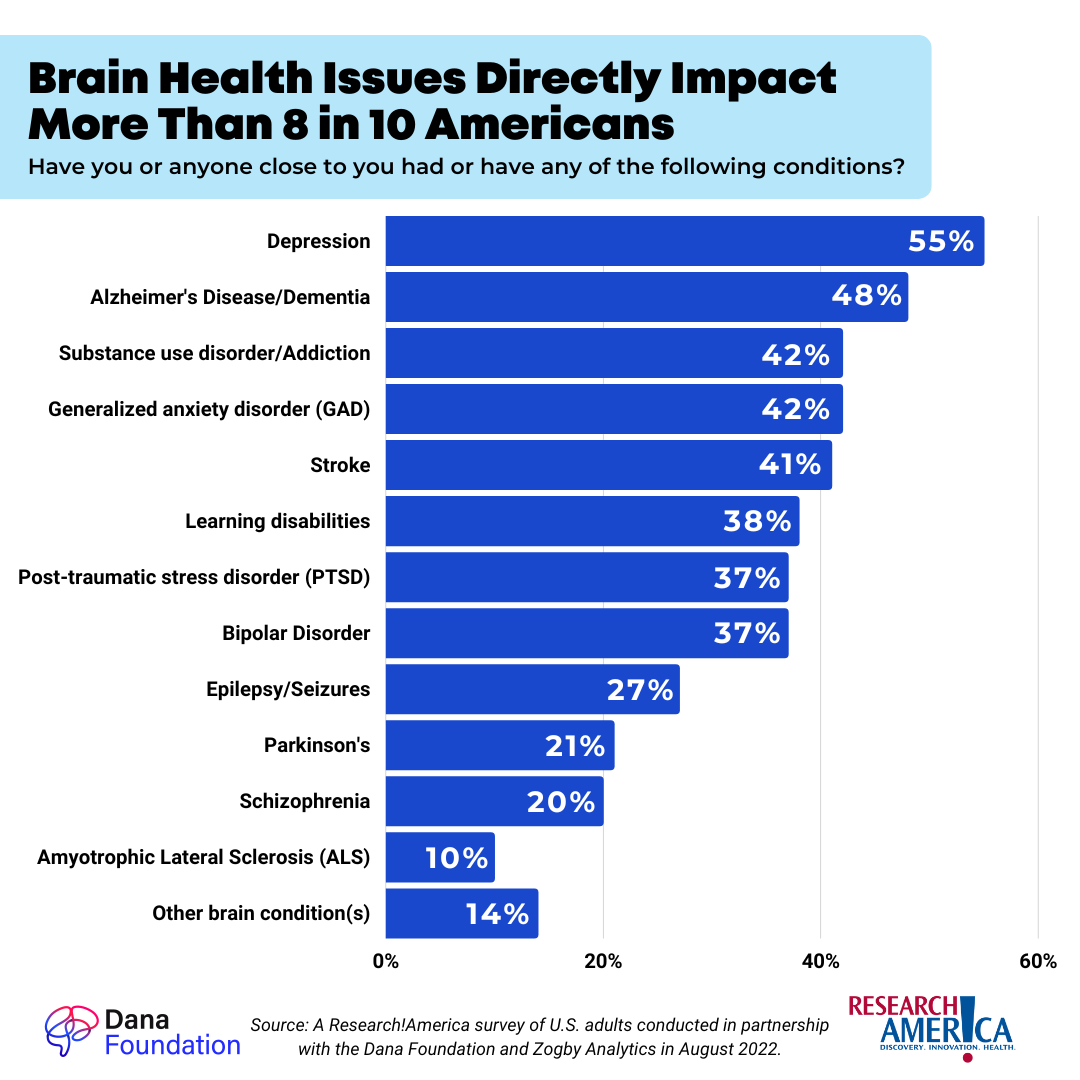
The need for new medical treatments could hardly be greater. A 2023 Research!America-Dana Foundation survey of Americans found that 82% of respondents say that they or someone close to them have experienced at least one brain health condition, with depression (55%), Alzheimer’s disease or dementia (48%), substance use disorder or addiction (42%), and generalized anxiety disorder (42%) the most frequent conditions.
At the NINDS forum, I heard that need expressed across patient communities. Patrick McCartney, executive director of the International Essential Tremor Foundation, described the realities of living with essential tremor, a neurological condition that can cause involuntary shaking of the hands, head, voice, or other parts of the body. An estimated 7 million to 10 million Americans live with the condition, yet treatment options remain limited.
Here, too, BRAIN-supported research is helping expand what may be possible. Researchers are developing closed-loop deep-brain stimulation systems[1] that can record neural activity and deliver stimulation when tremor-related signals are detected. Instead of continuously stimulating the brain, these adaptive systems aim to respond when—and as much as—an individual needs.
Bench to Bedside Requires Investment in the Ecosystem
These advances do not happen through scientific ingenuity alone. They depend on an ecosystem designed to move ideas responsibly from laboratories into people’s lives. The BRAIN Initiative has been distinctive in building that ecosystem intentionally, and in coordination through the BRAIN Initiative Alliance. Federal investment provides the scale, continuity, and shared infrastructure that no single university, company, or foundation can supply. Federally funded small-business grants enable researchers to become first-time entrepreneurs, turning emerging technologies into usable tools. Industry partners provide access to devices and engineering expertise, while early engagement with the Food and Drug Administration helps researchers anticipate the evidence needed to demonstrate safety and effectiveness. Philanthropic partners help convene communities and support promising new directions, such as American Brain Coalition’s SHARE and CARE patient community engagement platform. Patients and families bring knowledge that cannot be found in a dataset: which symptoms are most disruptive, which risks feel acceptable, what meaningful improvement looks like, and what would make a technology usable in daily life.
Collaboration is crucial. Since the earliest days of the BRAIN Initiative, neuroethics has been embedded as a partner in the research enterprise. Questions about privacy, identity, agency, consent, fairness, and access cannot be postponed until a treatment or technology is ready for the clinic. The BRAIN Initiative supports this work, including a current open call, “Strengthening Biomedical Research, Promoting Trust, and Improving Health through Bioethics Research.”
Federal Investment in the Science Ecosystem is the Engine of Progress
The larger lesson of the BRAIN Initiative is that progress requires fundamental discovery, talented researchers, public and private partners, thoughtful regulation, ethical inquiry, and the expertise of people whose lives are most directly affected. Remove any one of these elements, and the path from insight to impact becomes less certain.
Private foundations can, and should, take risks, build bridges, and contribute resources. But philanthropy cannot substitute for the reach and endurance of the federal government. Sustained federal investment is what allows the nation to pursue research whose outcomes are uncertain but whose potential value is immense.
At the BRAIN Initiative Conference, I saw researchers inventing new ways to understand the brain. At the NINDS forum, I met people actively engaging with researchers and eager for what their discoveries might bring. Our responsibility is to keep those communities connected, and to protect the investment that makes their shared hope possible.
Recommended Reading
New STAT Beat Explores What Shapes Trust in Science
From Principles to Practice: Advancing Neural Organoid Research for Societal Benefit