News & Insights
People Value Science. What Builds Their Trust?
A conversation with Erica Kimmerling and Eve Klein

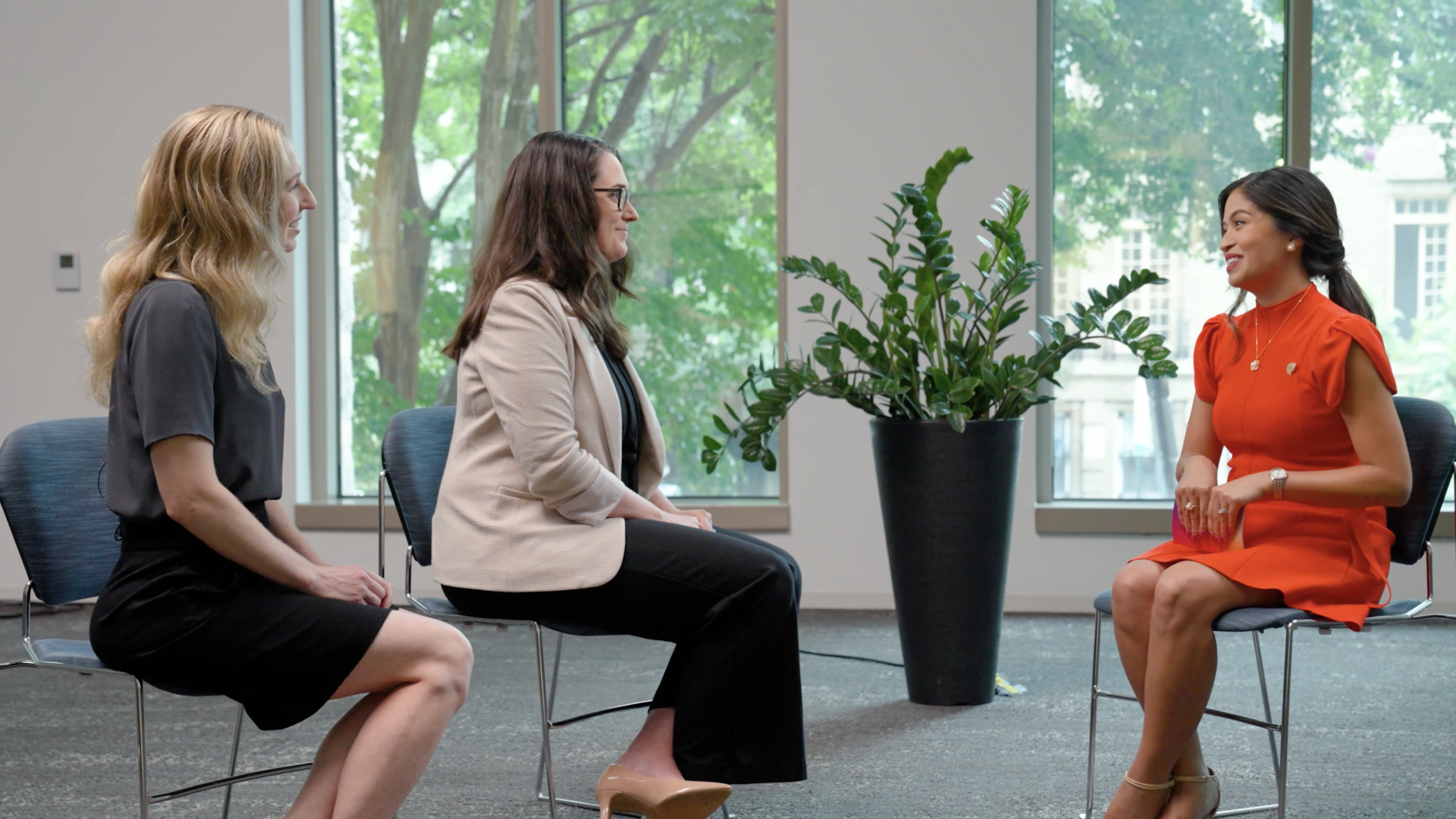
Eve Klein, Erica Kimmerling, and Caroline Montojo at the Association of Science and Technology Centers Headquarters in Washington, DC.
If you’ve ever visited San Francisco’s Exploratorium, or Chicago’s Museum of Science and Industry, you’ve encountered the Association of Science and Technology Centers’ (ASTC) network. The ASTC supports over 600 museums and institutions all over the globe where people can learn about and experience science in person.
Committed to strengthening connections between science and society, Senior Director Erica Kimmerling, Ph.D., and Senior Advisor Eve Klein, M.Ed., work together at ASTC to provide member organizations and the broader science engagement field with valuable insights into public attitudes.
In this episode of NeuroSociety Stories, Kimmerling and Klein sit down with Dana Foundation President and CEO Caroline Montojo, Ph.D., at the ASTC headquarters in Washington, DC to discuss what their research has taught them about trust in science today. Understanding how scientific institutions and scientists build that trust and engage with communities is central to the Dana Foundation’s mission to advance neuroscience for the benefit of all people.
Support for Science
In 2025, The Science Coalition polled over 1,500 registered voters and found that more than 8 in 10 Americans believe that it’s important for the US to be a leader in science. That same year, a survey conducted by the ASTC revealed that public attitudes towards science have not significantly shifted:
- 7 in 10 people say that science benefits “people like me”
- 9 in 10 respondents want federal investment in STEM Education
In fact, the survey conveyed increased public interest in engaging in issues at the intersection of science and society.
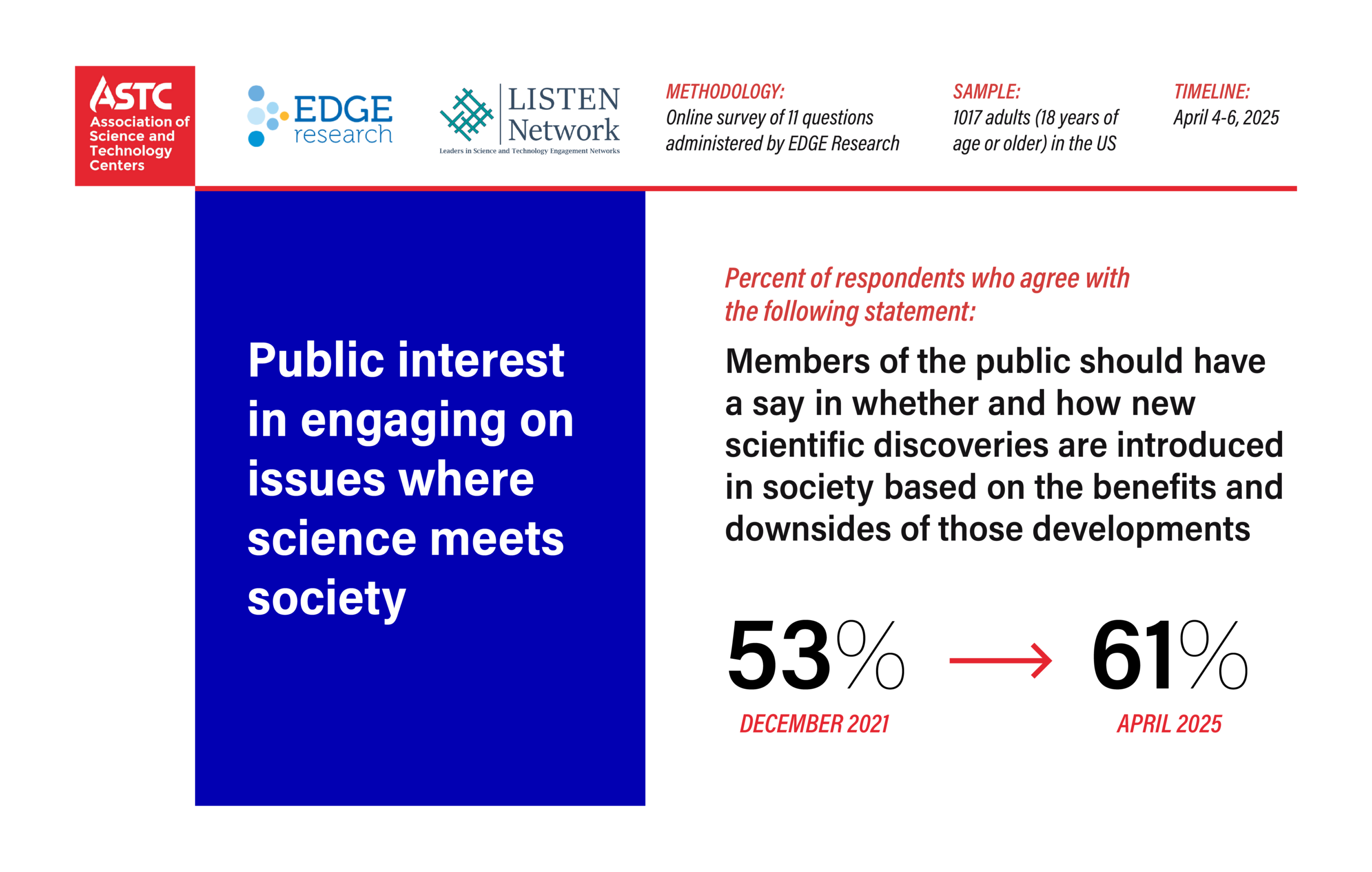
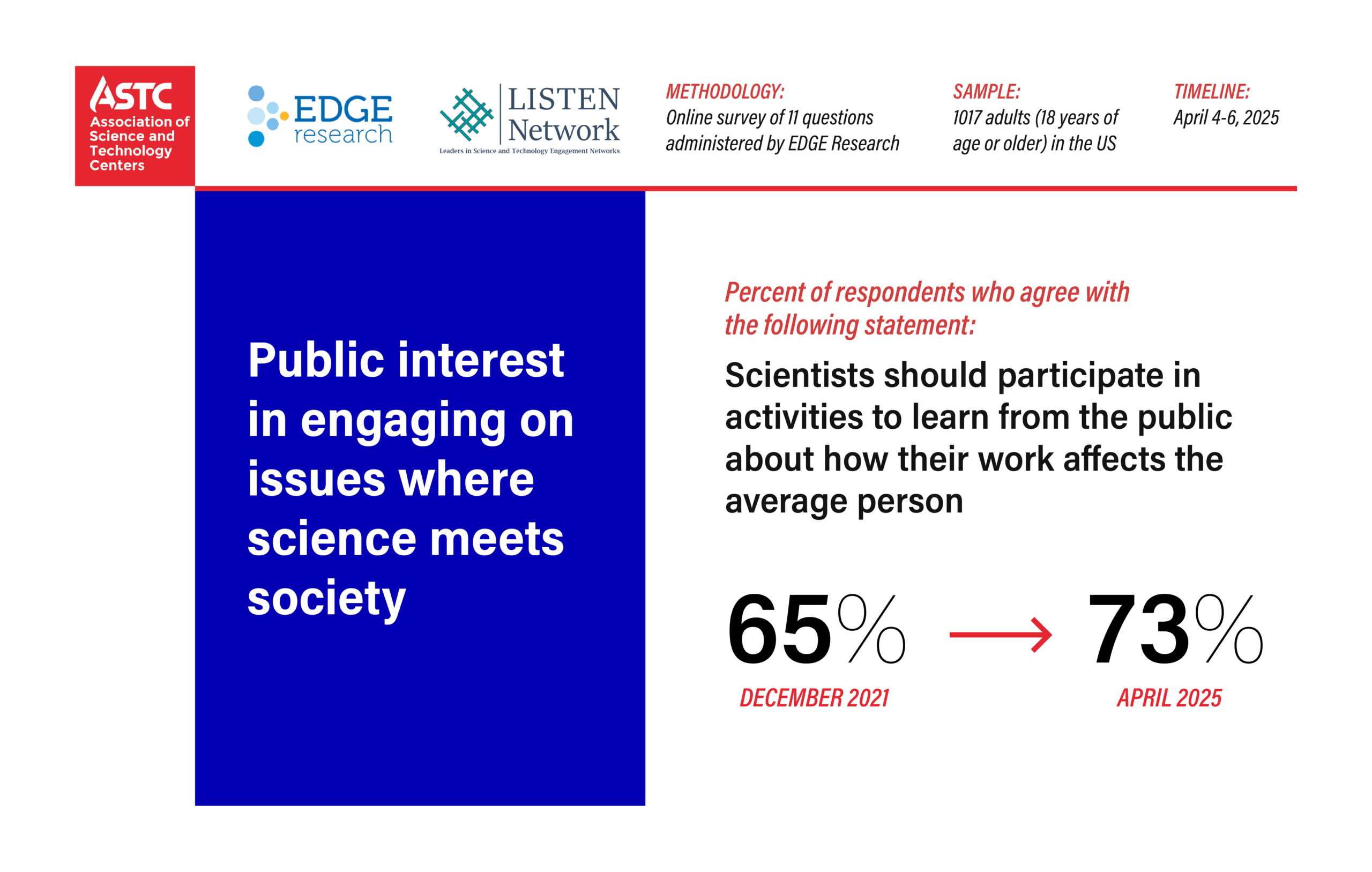
Source: Association of Science and Technology Centers, How U.S. Adults Perceive Science in this Moment, 2025. Graphic by the Dana Foundation.
“These are fantastic polling numbers. So the public understands the benefit of science. That was very clear in the data,” says Kimmerling.
Trust in Science
But broad support for science tells only part of the story; understanding trust requires a more nuanced set of questions. Klein and Kimmerling seek to unpack what “trust in science” is actually referring to. Is it trust in science as a process? Trust in the scientists, themselves? According to Klein, trust in both those areas remain high. “Where we see the degradation is around trust in the institutions that fund, that interpret, and that act on science,” she says.
Kimmerling encourages leaders of science institutions and public engagement practitioners to probe even further and ask, “Trust to what end? Why do we care about trust in science?”
“Is it trust because you want people to fund science? … Or is it trust because you want people to make science-informed decisions? And that’s going to be very, very, very different.”
By continuing to question why trust is necessary, they believe that science institutions can better understand how to build it and outline clear goals for engaging with communities.
But Klein warns that building trust between the public and institutions doesn’t guarantee social and behavior change. “The reality is people make decisions based on many other aspects, many other considerations, their value structures, what their neighbors are doing. It’s not just about whether they trust science or like science, there are a lot of things that inform how we make decisions.”
Science in the Background
Science nevertheless plays a routine, practical role in people’s lives. Nine out of 10 respondents reported using one or more of the eleven listed information types, such as weather forecasts, nutrition information, and air quality reports on a weekly basis.
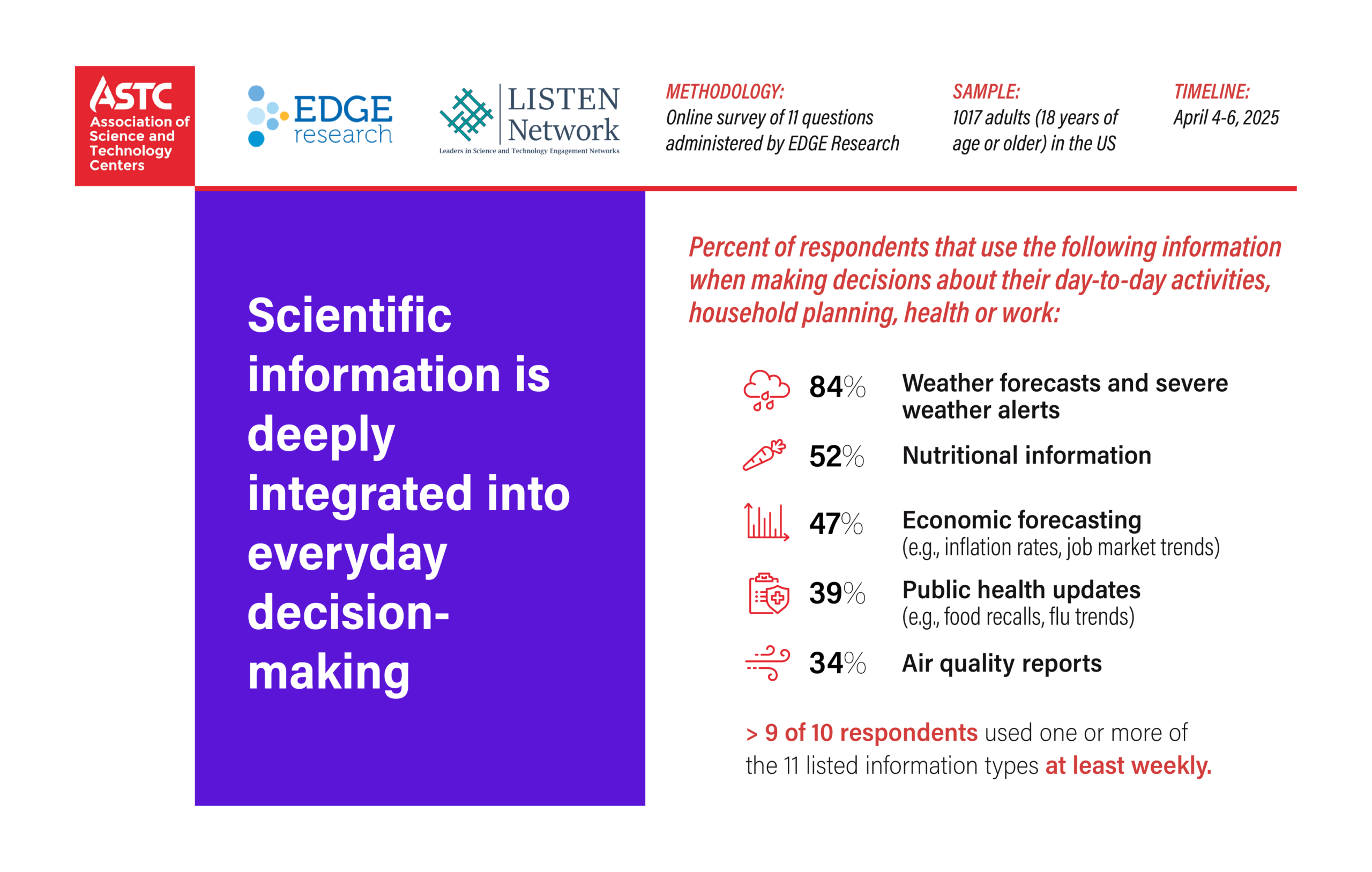
Source: Association of Science and Technology Centers, 2025. Graphic by the Dana Foundation.
But through focus groups, they realized that very few people could name the organizations behind the data they regularly engage with, such as the National Oceanic and Atmospheric Administration (NOAA), the infrastructure that supports the data collection that makes weather forecasting possible. Limited awareness may make it harder for people to recognize what is at stake when scientific infrastructure changes.
“How do you defend something that you don’t know exists?” Kimmerling poses. While the goal isn’t for every American to name each government agency, the outcomes of federal investment in science that people use and benefit from, present an opportunity to restore trust in institutions.
“Federal investment in science data collection is a massive success story, and we’re not looking for the credit, but at the same time, when we’re talking about low institutional trust in government and institutions, science is actually something that government does incredibly well. So it’s an amazing vehicle for thinking about building trust back in institutions because it’s something that can actually deliver real value on a daily basis—it’s just behind the scenes,” says Kimmerling.
Looking towards the future, Kimmerling and Klein share questions that the scientific community should be asking:
- How do we build institutions worthy of trust?
- What does it mean to be trustworthy?
- How do you earn the trust and confidence of people?
Watch Erica Kimmerling and Eve Klein’s full episode below and find previous episodes of NeuroSociety Stories here.
This transcript has been lightly edited for length and clarity. CAROLINE MONTOJO, HOST: Welcome to NeuroSociety Stories, a series created by the Dana Foundation that explores the incredible ways that neuroscience is shaping society. Through engaging conversations, we invite Dana Foundation grantees, partners, and other neuroscience and society thought leaders to share stories of discovery, innovation, and impact. Each episode offers unique perspectives on how brain science intersects with fields such as ethics, law, social sciences, and more. Advancing neuroscience for the good of all. I’m Caroline Montojo, president and CEO of the Dana Foundation. Join us as we uncover how neuroscience can drive change, inspire new possibilities, and create a future that reflects the aspirations of all people. MONTOJO: We’re living through a moment of real change in science. From shifts in federal policy, to rapid advances in AI, to evolving public trust and institutions. This is an inflection point that’s affecting every field, not just one discipline. As part of the NeuroSociety Stories series, we wanted to take a step back from a purely neuroscience focus and ask a broader question: What should the future relationship between science and society look like? Because at the end of the day, much of science is funded by the public. So how can research most meaningfully serve the public good? To explore that, I’m talking today with leaders who are working at the intersection of science and society. People who are rethinking how science is done, communicated and connected to communities. I am really pleased to be joined today by Erica Kimmerling and Eve Klein from the Association of Science and Technology Centers, ASTC, here in Washington, D.C. Erica is a senior director at ASTC and has previously served in the White House Office of Science and Technology Policy at the American Academy of Arts and Sciences and was a Civic Science Fellow. Eve is a senior advisor at ASTC. With over 20 years working at the intersection of science and society, Eve has served as a principal investigator on national research studies and networks that seek to better understand and strengthen the relationship between science and the public. Erica and Eve, I am so happy to have you here today. ERICA KIMMERLING AND EVE KLEIN: Thank you for having us. MONTOJO: Absolutely. To start, I’d love to hear about your career journeys. Erica, you trained as a biomedical engineer and Eve, you trained in education, but you’ve moved into roles that span this intersection of science and society, including the Civic Science Fellows program. Can you share what drew you to these boundary-spanning career paths? KIMMERLING: I’d like to say it was something that happened later in my career, but I can tell you, for me, this started when I was a kid and when I was in high school. So, I grew up in a town that was 15 minutes south of Brookhaven National Laboratory. And to the folks in the sciences, they know that as a world-class, world-renowned research institution with particle colliders and like the most high-tech equipment you could imagine. My community, from where I sat, knew nothing about what was happening in that lab, and it took me leaving my community and going to undergrad to learn how important that work was, what it was doing, how it was advancing society, like the critical things that were happening in that lab that were valuable to the members of my community, that just didn’t know about it. And that always felt wrong to me. It really started something in my brain like, is this really how it has to be that I have to now enter academia to know what’s happening in the sciences? So that, from the very beginning, had me going—this relationship, what we talk about as science and society, it should be different. There’s something missing here. And then, you know, doing my PhD and understanding all the questions that I was asking as a biomedical engineer had these societal implications and these policy implications. If you’re talking about new gene editing and what are the moral and ethical considerations? How does policy allow that to exist in the world? Doing all that work, what I realized is, I want it to be at the level of: well, how do we structurally attack these issues? Rather than communicating my science and maybe it reaches a few people, how do I make it so that more institutions can have better relationships with their communities? So rather than doing it just at the local level, thinking at the systems level—how can we build it and incentivize it so that more of these close relationships can happen, so that there aren’t the things that happened when I was a kid, where there was this great research and there was just no relationship. So that is where I found policy, and public engagement, and participation in science policy, and this whole world. And it wasn’t until I was a Civic Science Fellow that allowed me to find this community of other people who are thinking about these things at a systems level and realize—oh, we’re actually like in a moment where there are a bunch of people who are tackling these issues, who are asking the same questions, and now we can work together on different aspects of the problem, learn from each other, and amplify the lessons learned and really build this at scale. So we’re really at a critical moment for boundary spanning efforts at the interface of science and society. MONTOJO: That’s great. Thank you, Erica. It’s so powerful to hear you talk about growing up in a community right next to a national lab, and not knowing what it was until you went to college. Eve, I’d love to hear from you now. What drew you to such a boundary spanning career? KLEIN: You know, I think looking back, I can also see some indications in my early childhood that I might end up in this sort of cross-disciplinary space. My dad has a degree in math. My mom has a degree in art. So even when I was little, I think I was sort of encouraged or primed to think about the world from these really varied perspectives. And then in college, where I studied astronomy and philosophy. So again, still sort of trying to take these different perspectives, I had the chance to travel with a physics professor to South Africa through an outreach project, where we brought physics materials to some of the townships, and it was a really powerful experience, but prompted me to reflect a lot on what it is we were trying to accomplish. When we talk about strengthening the relationship between science and society, or sort of bringing science to people—what does that mean? What are we actually trying to achieve? How could we make sure that any public engagement work we were doing around science was really rooted in the community’s priorities, what the community was looking for and wanted to get out of their relationship with science. And I would say I’ve really spent the rest of my career exploring that. I’ve come at it from a science education, informal-science education perspective, science communication, thinking about partnerships between science learning institutions and higher ed. And now more recently, working with Erica in thinking about how we can better understand public perceptions of and values around science. MONTOJO: Wonderful. It sounds like that trip to South Africa was a very pivotal experience. KLEIN: It really was. Yeah, absolutely. MONTOJO: So I’d love to talk a little bit about the current moment that we find ourselves in science. There have been a lot of changes in the science enterprise over the past few years. Thinking about the pandemic, major advances in AI, and also shifts in public perceptions. Can you share how you would characterize this moment for science? What feels different about where we are now? And I think for this, I’ll start with Eve first. KLEIN: You know, I think I would characterize this moment as kind of a long time coming. So, I’ll do a quick little history lesson here. After World War Two, Vannevar Bush, who was a science administrator and an engineer, produced this report, Science, The Endless Frontier, in which he sort of laid out a vision for science in this country during peacetime. And it really emphasizes the importance of basic science, that is, science that doesn’t have an immediate, obvious application and yet still stands to provide real societal benefit over time. And it led directly to the formation of the National Science Foundation. And so it’s really been the shape of science and science policy in this country since then. There’s kind of a deal baked in, though, to that model, which is that scientists receive funding through universities. They receive freedom to explore the questions that they deem as highest priority, in exchange for public trust that ultimately science will provide public benefit. And what we’ve seen since about the 1960s is that that trust is really starting to degrade. And so that’s why I say, again, this is sort of what we’re seeing now is really a continuation of a longer trend. So, in the 1960s, we have, you know, Vietnam War and Watergate, and there’s been a trend of declining trust in institutions for many, many decades. And then, of course, Covid posed a huge challenge for the broader scientific enterprise. And now in this moment, we’re seeing two really powerful forcing mechanisms. We’re seeing the major changes in structure and funding that this administration is bringing about. And we’re seeing the introduction of new AI technologies. And, you know, AI is fundamentally changing the way science is done. And it has huge implications for training future generations of scientists. It’s dramatically changing the skillsets that are going to be necessary to work in science going forward. And it’s also changing the way people get their information; when and where and how they get their information. And so we need to be acclimating to all of that. There’s also this tension between really low levels of trust in AI technologies among members of the public and really high levels of use. So there are all these sort of, interrelated strands. And we don’t yet know exactly how those are going to play out, but it is having already really significant impact on science. So, I think again, it’s both a continuation of an ongoing trend and a very unprecedented moment. And I think for us to see a future where science is able to have the kinds of public impact that I think we all hope for, we really need to be revisiting some of the basic structures and the incentive structures that science relies on. MONTOJO: That’s great, Eve, I love how you explained that. And it feels like, as you were describing it, multiple tectonic plates shifting at the same time—both some that were long time coming and some that are more near term. And so, it’s very helpful. Erica, anything else you’d like to share? KIMMERLING: In a post-Covid world, in an AI world, as digital tools expand, what we’re seeing is more people are looking for science on their own. They want to find the source of the information. They want to do their own research. But the institutions and the structures by which we house scientific information have not changed over time. When you think about a scientific article, it is not written for a public audience. Yet, more and more people, especially if we push to open it up, are reading it. And so we have this appetite for the information, to do it themselves. And we should encourage that, frankly. And also institutions that were not built for people to engage with. And that is coming to a head because science has long taken a kind of paternalistic approach. We’re going to publish it and talk about it with our communities, and then we will tell you the information, and we’re going to kind of be the gatekeepers, as you know, credentialed scientists and engineers. And we now have to think about, in this relationship, how do we build the structures where there aren’t gatekeepers, but there’s still accurate information and an ability to understand what this data means. So I think this kind of digital moment that we’re in, we really have to rethink these structures. MONTOJO: Now I’d like to shift to some of the work that you’re doing as part of ASTC. There is a lot of discussion right now around trust in science and institutions. In your work at ASTC you’ve led efforts to better understand public perceptions of science. Can you share about that work? What are you learning about how people perceive science and institutions? KIMMERLING: Taking a step back, for ASTC, we’re an organization of science and technology centers, brick and mortar institutions where people come to visit and experience and learn about science. So we have a long-standing history of trying to understand how people want to engage in science, what their interests are, and using that to inform our members and our community. You know, in 2024, when we started to see these kind of massive shifts in federal science policy and support for science. A lot of narratives started bubbling up about, well, what does this say about the relationship between the public and science? And we realized there wasn’t a lot of data underlying the narratives that were coming up in that moment and were like, okay, we need a pulse check. So we fielded a survey in early 2024 to take that pulse check. And it turns out public attitudes toward science have not significantly shifted. There had been that slight decline in trust in science post-Covid, but that’s actually even starting to bump up. What we’re seeing is that if you, at a top line, ask the public about science, 8 in 10 people say that publicly-funded science is valuable to them. 9 in 10 people want federal investment in STEM education. Science benefits people like me, I think that’s 7 in 10. These are numbers that—really nothing pulls that well. These are fantastic polling numbers. So, the public understands the benefit of science. That was very clear in the data. So that was one thing where we’re like, okay, that narrative that this is because of massive erosion of trust. It doesn’t hold water. Then we wanted to probe a little bit deeper because as we’ve been talking about, well, confidence has remained high, the difference is science at an institutional level and individual level. What does that mean? So we’ve actually continued to do additional quantitative and qualitative research to try and tease apart: What is trust at an institutional level? What helps build trust and how are people engaging with these institutions? So we’re continuing to collect that data and really understand that relationship at a granular level and a more actionable level. And where there are some vulnerabilities for scientific institutions. The question we like to ask: Trust, to what end? Why do you care about trust in science? So then we’ll start to dig into it. Is it trust because you want people to fund science, in which case, we see that the support for like publicly funded science is high. Or is it trust because you want people to make science-informed decisions? That’s going to be very, very, very different. And there is an erosion of trust around, say, vaccines. We are seeing those trends, but that’s different than general trust. So what we’re trying to help the scientific community and our broader community understand is, you have to ask: trust to what end? You have to understand why you care about trust in order to actually get usable information for how to build that trust and where there’s opportunities for us to do more. KLEIN: I was just going to build on that and say, one of the other pieces that we try to sort of pull apart is affinity for science, or again, trust in science does not necessarily translate to the kinds of decision making that we think a lot of people in this space hope it will. The reality is people make decisions based on many other aspects, many other considerations, their value structures, what their neighbors are doing. It’s not just about whether or not they trust science or like science. There are a lot of things that inform how we make decisions, and that goes for all of us. And so I think that’s part of what we’re trying to… that’s kind of part of what we’re trying to get out there through our data. The influences on decision making are not the same as sort of building trust in or affinity for science. MONTOJO: Great, great. Well, now I’d like to also ask, as you think about all of this data that you’ve been able to collect on public perceptions of science. Were there any of these findings that were surprising to you? And maybe another aspect of this is what do you think is the most important takeaway that scientists, institutions and funders should bring with them from this data? KLEIN: I think the most surprising finding for me, although maybe I shouldn’t be surprised, is that almost half of the respondents to our survey said that they assumed wealthy individuals, philanthropies, corporations would be able to step in and fill any gaps left by receding public funding, receding federal funding for science. And, you know, that suggests a fundamental misunderstanding, a very common and reasonable misunderstanding of how federal science works. The time scale and the financial scale of work that federal money has been able to support, it cannot be replaced by this private money. For scientists, there’s been so much energy around scientists doing direct public communications. I’ve personally been involved with a lot of that in my career, and I think this is a moment where we want to rethink what the focus of that work is. And instead of talking about the findings or even focus on the science content, we need to now elevate conversations about the process. How does science work? Who is at the table making these decisions about what research questions are prioritized? What are the incentive structures and drivers. And I think it means talking about that, warts and all. You know, being real about where science works, where science is hard, where science is complicated. I think what we’re seeing is members of the public don’t just want to be told what the findings are, they want to understand how we arrived at those findings. I also think there is an opportunity to channel some of this energy we’re seeing among scientists, not just towards communication, but towards advocacy. And I don’t just mean advocacy, sort of in the broader political sphere, but even within their own institutions. We, as part of our survey work, asked, what are some of the practices that would increase your confidence in science? People told us that things like, again, being open and transparent about processes, replicating studies, publishing null results, all of those things we heard would build confidence in science. And we all know these are things that are not currently incentivized by most science institutions, and so there might be an opportunity now for scientists to work within their organizations to really push for some of those practices to be added to promotion and tenure packages, etc. And so for the institutions, I would say, rethinking the way they incentivize science, the way science is done and looking for more channels for public input and public involvement in some of these processes. MONTOJO: I also really appreciate your point about focusing on the science process. I think that’s a very different approach to science communication than we’ve seen in many situations. You know, we’ll be talking about the end findings. Right? The sort of, varnished parts of science. But it’s a very human endeavor. I think talking about that process and the role of people within that is very important. KLEIN: Absolutely. MONTOJO: Erica, anything else you wanted to add to that? KIMMERLING: The thing that jumps out to me when I think about our data is we asked a very simple question about do you use this information in your daily life? We asked about weather, public health reports, air quality, and 9 in 10 people said they used one of this list of eleven different sources of information, at least daily. Weather being the most common. You know, we call that science. We call that data. We just called it information because we try and keep jargon out of polling questions in order to really understand usage. So we saw this high use of weather information. We did focus groups. We actually talked about, well, where do you get your weather from? How do you think about the weather? Where does that data come from? In several focus groups and having these conversations about it, no one clearly named NOAA. They think about their local TV stations, the apps on their phone, but the infrastructure of data collection that happens at scale that we know as people who are in Washington, D.C., and think about these institutions, know the level of investment that goes into having advanced radar, and things like that. That is not visible to the average person, nor would you expect it to be, because most people don’t think about when they’re opening their weather app. They’re not going to go on a long journey and thinking about where that comes from. MONTOJO: Thank you, science! KIMMERLING: Yeah, thank you science! I don’t think the expectation is that people are thinking that. We shouldn’t encourage that, but at the same time, when we then say, well, a lot is changing to the federal infrastructure and people are not defending science against changes. Well, how do you defend something that you don’t know exists? Just telling them it exists isn’t going to change that fact. At the same time, these things can’t be so invisible that people don’t know the things that their tax dollars are going to, that have created reliable weather protections and public health notifications and clean water and clean air. We only look at the problems like, this is one of those things that we only see science when it goes wrong or when it does, like the miracle breakthrough. But the level of data collection and science in our daily lives tends to just hum along in the background. And what it raises to me is, how do you really increase that visibility so that people who are interested in it or are supportive of it, know that it’s there and can engage with it? KLEIN: And I think our goal really isn’t necessarily for people to be able to identify specifically what the CDC is responsible for versus what NOAA is responsible for, versus what NASA is responsible for. But what we do hope for, is for folks to begin to recognize the ways in which they are encountering the products of federal investment in science throughout the course of any given day. KIMMERLING: Federal investment in science and data collection is a massive success story, and we’re not looking for the credit. But at the same time, when we’re talking about low institutional trust in government and institutions, science is actually something that government does incredibly well. So it’s an amazing vehicle for thinking about building trust back in institutions, because it’s something that can actually deliver real value on a daily basis. It’s just behind the scenes. So it’s almost a way we can think about how people have relationships with these institutions that have actually started to erode. MONTOJO: Thank you for sharing that. So now I’d love to hear in this context, you were talking about the social contract earlier. This “more than 75-year-old contract” between science and society. I also like the fact that you talked about the sort of deal that in return for the investment in science and research is also public benefit. That is an expectation. So, as you tie together the work that you’ve been doing in your career paths at ASTC with this Public Perceptions of Science survey, as well as the trends that you’re seeing in the science enterprise, how do you think we should be thinking about the future of science? KIMMERLING: When we think about the future of science from where we sit and based on everything we’re seeing, the data, it’s really about how do we build institutions worthy of trust? What does it mean to be trustworthy? Let’s stop with the, what are we using it for? But like, how do you earn the trust and competence of people? And we’re thinking about, well, what are the policies we need to put in place for institutions to be responsive, accessible, transparent, engaged? Those are things that while science is delivering great value on a regular basis, those practices are not currently incentivized within the ecosystem of science. And we can be doing more. So we think a lot about what are the structures that we can use. Some of that is creating more space for public dialogue and participation in things like science policy. So how do we create forums for conversation into decision making around regulation or ethical issues in science? You work in neuroscience. There are so many ethical, value-based decisions where the science ends and the impact on people’s lives or people’s morals come into play. We need more spaces for those conversations to happen. And the theory of the case being that, if you create space for those conversations to happen, there is that relationship. There’s that long term work of building trust with communities so that when you need to have them make a decision about something that’s related to their life, they have a relationship. They’ve been having these conversations with these institutions long before, kind of a crisis point. So we think a lot about it in terms of creating space for dialogue. The other thing we are working a lot on is we’ve talked about how people are seeking information on their own. They’re doing this independently, looking for the information. They want to find the sources. Something that’s missing is how do we help people ask good questions of their institutions? We want institutions to be accountable and responsive to them, but there’s a whole information gap about how these things actually work and who’s doing the work, who’s making the decisions that make it really hard for people to effectively engage and ask for accountability of their institutions. So we’re thinking a lot about, as people and professionals that work in science engagement, how do we support people in asking these questions? What kind of background knowledge they need to answer? How do we create space for them to ask those questions? And that’s an important part of it. And it’s not a science literacy model from just like a “you need to know more in order to love science.” It’s a, how do we give you the right information so that you can interrogate the system yourself? And there’s so much more to be done. It’s such an exciting area of work, really thinking about how do we support communities and individuals in asking the right questions of science based on their own interests and priorities and values, like, what are the questions that they need to be asking to get the good information, good answers? MONTOJO: Erica, when you just talked about helping people to ask better questions of the science system and the process, can you give an example of what a better question could look like. KIMMERLING: Knowing who you want to talk to and who’s involved and who’s part of a process allows you to ask questions about their reliability, their level of effort. Do they have conflicts of interest? And it’s starting to unpack the different players in the structures that exist. A lot of people don’t know that there are advisory panels that make decisions and that they have to report conflict of interest or that in a scientific study, if you are paid by pharma, you tend to declare that within the paper itself. So helping people understand these kind of hidden systems and talking about that and then asking the real questions about, well, was this study robust enough? What would make it robust? There’s just a layer deeper of like, let’s have the conversation about what makes something useful and actionable and why the scientists come to that conclusion, and where there’s variability and you have to know a little bit more about each player within a structure, how they make decisions, what their role is in order to be able to interrogate their specific actions in those roles. Just creating visibility into all those different roles is a way we help people ask a better question, so they know who actually is making the decision. Sometimes it’s not the scientist, sometimes it’s a policymaker, in which case there is a bunch of different other concerns. So really creating that visibility into those structures and processes. MONTOJO: That’s great. it sounds like it’s a combination of understanding what the system is, who the different players are, and also, maybe one thing that comes to my mind is being able to access the right channels to be able to share questions or feedback that one might have about a given scientific discovery, or how it might relate to their life. KLEIN: Take that even a step further and say, I think a real opportunity in the future is building on this movement around community science, where communities actually get to determine what the research questions are and get to share themselves what they think we should be examining, and even participate in some cases in the process itself. I think this is a moment where people want to be able to use the tools of science to answer the questions that they themselves have that will better their own communities. So I think this is a real moment for that kind of work. KIMMERLING: In thinking about community driven science and questions and research, I tend to think now as a biomedical engineer of the applied medical sciences. And we often are like, well, what is the thing that’s going to treat that disease, cure the disease? And that comes from a ‘we want to know about a pathway and a mechanism so that we can we can go at it.’ That’s not how people experience treatments within their body. And when we talk about asking good questions and asking questions with community, does it come at a cost? Does that treatment mean you don’t sleep well? That you don’t have the energy to interact with your family? And it’s like when you’re saying, what is the right question for a clinical trial? What are the outcomes and endpoints? It’s not just, are you eradicating the symptoms of an illness, it’s can someone have quality of life? Who defines quality of life? That’s not a scientific question. It’s the people who are living their lives. And I think in those spaces especially, there’s not one clear answer. So the more people who have input into that process of, say, designing, what the right endpoints are, the better that that trial will work for people in the long run, and probably the better outcomes, because people actually stick with the treatment for longer because it’s not diminishing the things that they care most about. MONTOJO: That’s fantastic. Erica, it makes me think about the importance of epistemic humility. So, being able to respect and bring into the fold different forms of knowledge science brings, from your example. It’s so important to think about different forms of knowledge and people’s lived experience and how that meets science. Well, I want to thank you both so much for joining me today. It’s wonderful to hear about your work. Fascinating to hear about public perceptions of science and also your views for the future of the enterprise, and really appreciate how you put people in the center—people and communities in the center of your work.TRANSCRIPT: