Impact Story
Who Sets the Agenda for Community Engagement?
How the Chicago Council on Science and Technology listened to residents and built brain health programs around their priorities
A 2025 Dana story followed this project through its first two events.
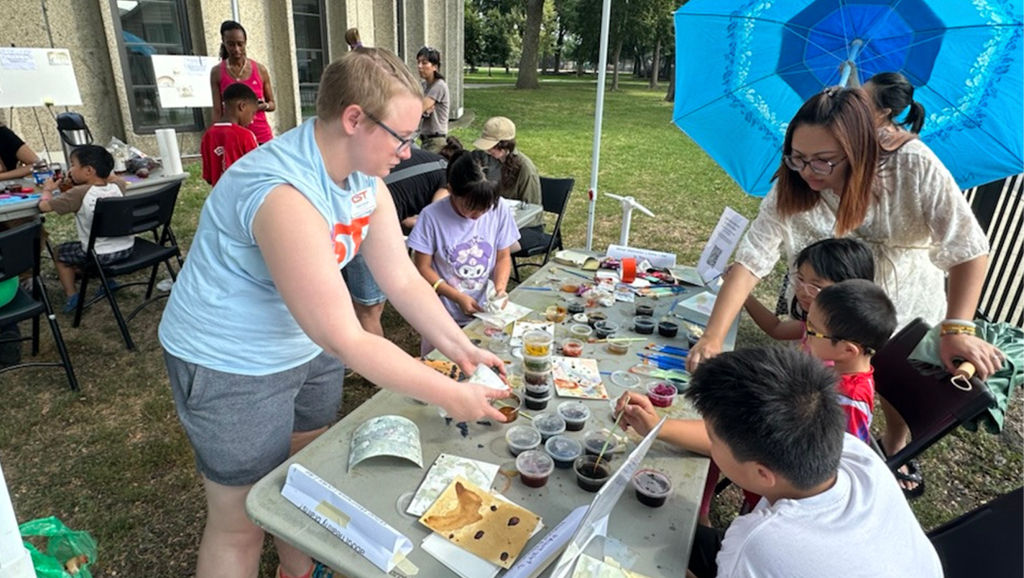
On an August afternoon in a park in Bridgeport, Chicago, children were pulling color out of vegetables. Beets, turmeric, and red cabbage, mashed and strained into little pots, then painted onto paper. The Chicago Council on Science and Technology had set up tables at Palmisano Park with snacks, art supplies, and no fixed agenda, and the children took to it at once. The adults stood at the edge of the grass and watched. After some hesitation, a few adults joined in.
“Brain Garden: The Art of Self-care,” held in August 2024, was the first of three events C2ST built with a $150,000 grant from the Dana Foundation, awarded in December 2023. It was designed as an open-space park drop-in: art, free snacks, and a conversation about brain health for anyone who wanted one, with nothing scheduled and nobody obliged to stay. C2ST partnered with Worldview Studio, a California design studio that ran the research while C2ST brought the Chicago relationships and put on the events. Between them the project drew on fourteen partner organizations and reached 435 people over eighteen months.
C2ST runs about thirty programs a year, and executive director Alexandra “Sasha” Prokuda, Ph.D., describes its operations “as a village with its partners.” The grant intentionally supported listening first and began a year before anything was programmed. The funds stayed flexible so that each event could be fine-tuned based on what they learned from the earlier ones.
Deep listening
Before the three events took place, the team spent months trying to learn what people actually thought about their brains, and what they hoped for, feared, and wanted to know. C2ST reviewed more than sixty pieces of literature, media, and survey data, and interviewed Chicago residents, many from neighborhoods that scientific institutions have historically reached past rather than into. They used the tools of human-centered design: ethnographic interviews, video diaries in which people recorded themselves over days instead of answering questions in one sitting, and a workshop with community leaders. Everyone who took part was offered payment.
Mostly, what came back was that few people talked about brain health. “I can’t really specifically remember any conversations about brain health with friends or family members,” one participant told the researchers, in material later published in the project’s public report. The exception was households already living with neurological conditions: “Brain health actually comes up a lot in my family, just due to Alzheimer’s and dementia,” said another participant.
What people asked for was to focus on the daily routine. “I would first like to know how to keep my brain healthy and activities I can do,” one wrote.
The topics that surfaced as most meaningful were stress, rest, nutrition, and community belonging. Those, the project’s closing report to Dana notes, “didn’t always align with what academic literature or institutional frameworks identify as core brain health concerns. This gap underscored the value of designing with, not just for, communities, especially when lived experience doesn’t fit neatly into expert-defined categories.”
“We funded this project because we wanted to know what communities themselves think about brain health, not what we assume they think,” said Devon Collins, Ph.D., who directs the Dana Frontiers program. “The project was designed to surface concerns that may not be on the radar of informal science educators or public health professionals. That’s what it did.”
In the leaders’ workshop, someone went further: “It’s not always about [individual ‘fixes’], there are structural issues like racism, financial strain, and time constraints that matter too.”
A second finding went to trust. “Mistrust of science is often abstract,” the report to Dana says. “Individual community experts are met with trust. While some people expressed skepticism about institutions or research in general, they were eager to talk with local experts, therapists, and organizers they recognized or could relate to.”
Talking about brain as part of everyday life
The next event was designed for the adults who had stood at the edge of the grass.
In February 2025, in Amburg Hall at Bethel New Life in Austin, on the West Side, C2ST ran “Mind Matters.” It was an indoor event built around one question: How do our brains shape our lives, and how can we care for them together?
The centerpiece was a panel that dissolved, on purpose. Community experts in mental health, nutrition, neuroscience, and wellness introduced themselves and held a discussion at the front of the room. Then the panelists spread out, joining attendees at their own tables. Around them were people offering sound meditation, a memory video game, health screenings, a benefits desk, and a brain-food buffet. The mix of hands-on and discussion activities, the report to Dana says, “invited adults to participate without it feeling kid-oriented, an update based on insights from our previous event.”
One of the people who spoke was Louis Alamilla, a registered dietitian at Alivio Medical Center. He talked about food and the brain, aimed mostly at older adults worried about memory loss, and pointed people toward the MIND diet, a combination of the Mediterranean and DASH diets. “I didn’t know that berries and leafy greens were something that was already helping me out,” people told him.
Another panelist raised mental health and the stigma around men talking about it, and Alamilla, who had come to talk about food, picked it up.
“I’m a guy,” he said, “and something I’ve been working on is addressing mental health concerns.” His partner had pushed him to talk about how he was doing instead of keeping things to himself. “She’s the one that advocated on the importance of mental health—hey, it’s always good to talk about how you’re doing, how to express your feelings, not just bottle up what’s going on with you.”
People stayed and told stories. They gave their own definitions of brain health. And they kept talking.
“People are interested in improving their lives, not just avoiding illness,” the report to Dana says. Community members engaged more when brain health was framed as everyday wellbeing, reducing stress, improving focus, connecting with others, than when it was framed as preventing disease.
“You go to a doctor’s office and they tell you: oh, you’re sick, take this medication. It’s pretty dry,” Alamilla said. “Versus you go to anything that’s lifestyle-related, and people are happier and willing to help. Because we had the video games, the sound meditation, the nutritionist, the therapist—a very holistic approach—people were more receptive and more eager to talk and learn more.”
Where the crowd already was
Fifty-one people came to “Brain Garden.” Thirty-four came to “Mind Matters.” Both were free, and both were advertised.
Standalone events cost money to promote, and C2ST’s budget for that was limited. So for the third event, in June 2025, it stopped staging its own event and set up inside somebody else’s: the Juneteenth celebration at the DuSable Black History Museum.
Three hundred and fifty people came to their tables.
C2ST already knew the building. It had run a solar eclipse viewing there in spring 2024, and at that year’s Juneteenth festival it had set up a science lab with microscopes and Chicago native plants and animals, staffed by four graduate researchers. The two Dana-funded community events had been held in other Chicago neighborhoods, though the research behind them had included South Siders. “This [previous experience] allowed us to take lessons learned from the other two events,” Prokuda said, “but use input from our partner organization to adapt it to the South Side.”
At “Brain EmPower,” visitors met a registered dietitian; a ceremonial dancer and racial-healing facilitator; a horticultural therapist studying herbalism and mental health counseling; and a licensed social worker. They also had the opportunity to participate in chair yoga and color sheets outlining parts of the brain—three girls in braids worked through the afternoon with crayons and ink stamps.
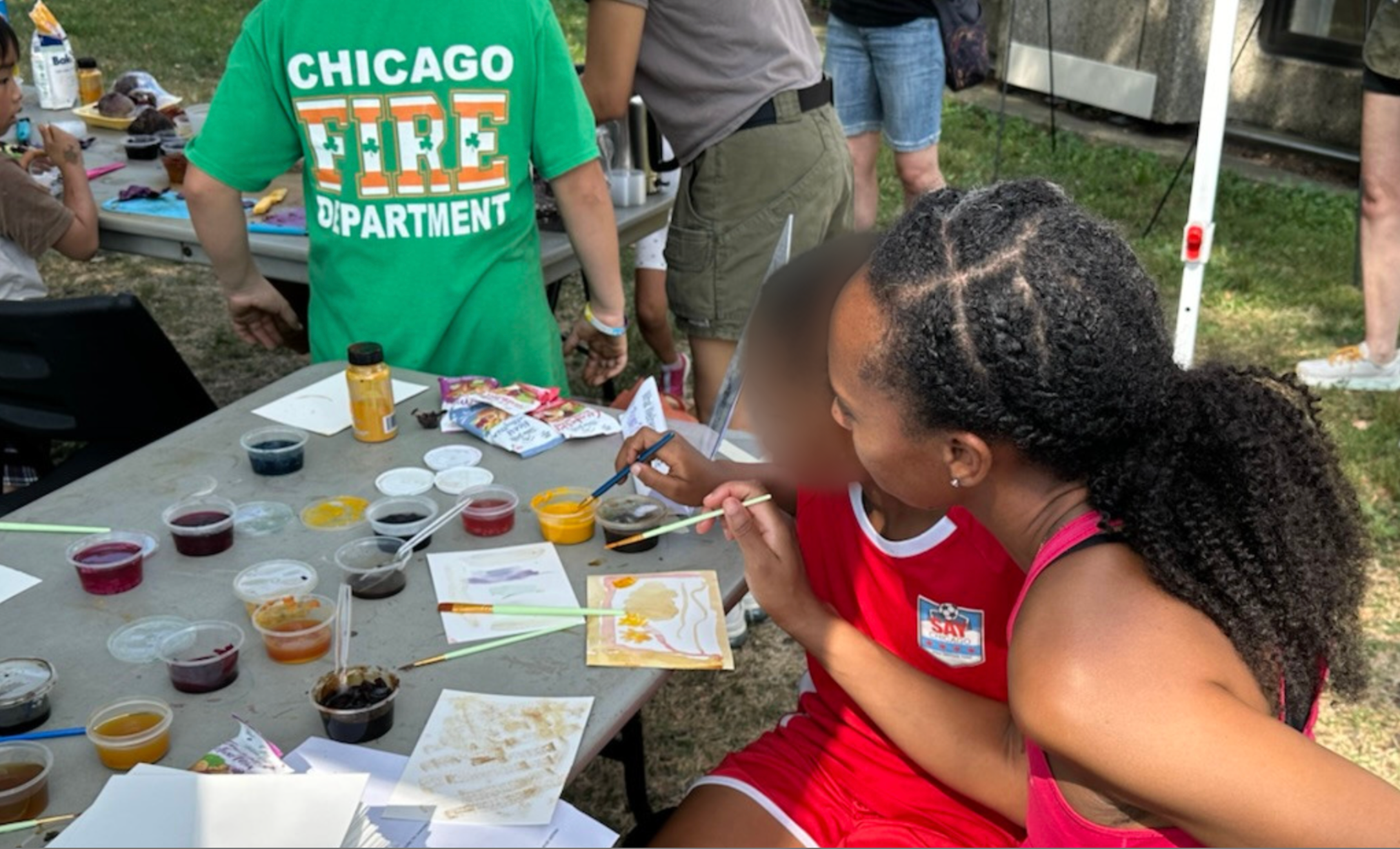
The watercolor table at a C2ST event. Photo courtesy of C2ST.
A bilingual board posed a question in English and Spanish: “How do you support your brain health?” The space filled with Post-it notes without anyone being asked to participate.
A resource table was set up with nobody standing behind it, deliberately, so that people could take what they needed “without fear of judgment,” the report to Dana says. Among the leaflets: information on traumatic brain injury caused by domestic violence.
At “Mind Matters,” Alamilla had brought nothing to hand out. This time he decided to make his own materials—a sheet of five foods that support brain health and recipes people could prepare at home.
The recipes used bananas and berries, which happened to be exactly what was on the snack table, and which turned out to be the most popular thing there. The food trucks outside had long lines. “Really good brain food,” Alamilla said.
The team kept noticing the same hesitation: people did not believe the free resources were free. Attendees were skeptical of the “no strings attached” offer, the report says, until they saw that nothing was being asked of them in return.
Alamilla could explain why. At a typical health screening, he said, you ask people for a name, an email, a phone number, as a record of who came. “People assume: hey, it’s probably me giving my information, they’re gonna contact me. I don’t want to do that.” Once it was clear the resources were free and nothing was being collected, people took things and took extras for people who weren’t there.
Alamilla also brought someone: Cheyenne Dyer, MSW, a friend from college, now a clinical therapist at Haymarket Center. Alamilla asked whether he could come; C2ST said yes and put him on the program. Dyer spent the day handing out resources on mental health, addiction, and behavioral health services, subjects C2ST hadn’t otherwise covered.
What worked, and what didn’t
As reported to Dana, each event was “directly informed by the priorities and ideas shared by participants of the previous event.” In May 2025 the two organizations took the work to a science communication conference, under a title that doubled as a challenge to their own field: Whose Agenda?
They distilled what they’d learned as eight design rules, listed at the end of this story.
They also changed what counted as success, letting the community leaders set the terms. Attendance wasn’t on the list. Instead, they tracked how long people stayed, whether they asked questions, whether they left with strategies they could use, whether they left with more questions, and whether they felt proud of themselves “without centering productivity.” The last metric was whether attendance reflected the BIPOC, queer, trans, and disabled communities the project intended to include.
And C2ST paid people. Every partner organization, every survey participant, and every community leader was offered an honorarium. Alamilla confirms he was paid, and so was Dyer.
Not everything worked. Four hundred and thirty-five people came to the three events; roughly seventeen filled in a survey. The rest of the evidence is observation, comment boards, and conversation.
Some community leaders drifted away. They “had a lot of great input at the start,” the report to Dana says, but their own schedules and the timing of some of the events made it hard for them to keep collaborating. Follow-up “proved challenging during a busy event season.”
Prokuda says it’s not a problem of good will. “Everyone who does this work is committed and open to collaboration,” she said. “But there is a lot to do, and time and resources are limited. We understand that because we’re in it and know when a partner is at their limit. They trust us not to put more work on them when there isn’t much to gain in terms of their mission.”
Even within these constraints, C2ST’s events uncovered valuable insights for future community programs. They showcased how people value information and engagement around brain health that align with their agency, practical priorities, and daily routines. By paying attention to where people naturally spend time, and what they are already doing in their communities, C2ST provided content and programming that showcased everyday actions people can take to support themselves and their families.
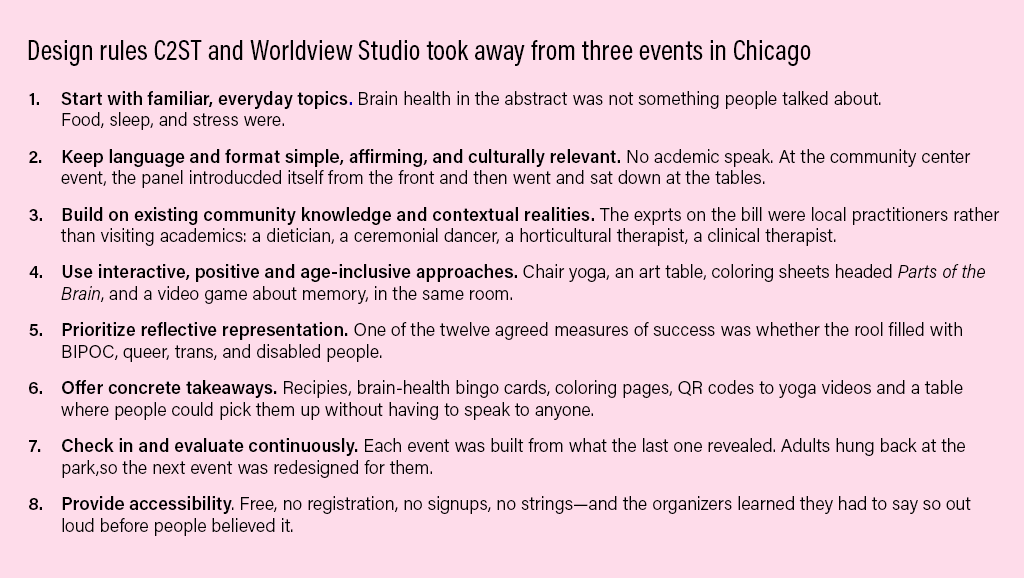
Adapted from the Brain Attitudes Project public report, Chicago Council on Science and Technology and Worldview Studio.
Recommended Reading
New STAT Beat Explores What Shapes Trust in Science
Clinicians, Caretakers, and Creativity Return to the Stage in UnRavelled